Dynamics in the mix
A master can only be as dense as the mix allows cleanly. If a few parts poke out far above the rest, the master limiter has to pull the whole track down every time they hit, and that is what you hear as pumping and lost punch. Controlling those parts in the mix lets the limiter do less for the same loudness.
The tools
- Compressor
- Turns a part down when it goes over a threshold, by a ratio. Attack sets how quickly it reacts (slower lets the transient through), release how quickly it lets go. Use it to even out vocals, bass and buses.
- Clipper
- Shaves off the very tops of waveforms instantly. On a drum bus, a dB or two of clipping takes the sharpest transients off with little audible change. It adds bright harmonics, so watch the codec peak on the master.
- De-esser
- A compressor that only reacts to harsh "s" and "t" sounds, or any bright, spiky part: hats, a bright synth.
- Saturation
- Gentle distortion that adds harmonics and density to sustained parts without the pumping of heavy compression.
Find what the limiter is fighting
MasterScope's Louder at −14 panel splits your track into six ranges and shows two things for each: its share of the height of the loudest peaks, and its share of the loudness. A range with a long amber bar and a short blue one spends peak room without adding much loudness. It then tests the fix on your actual audio: taking 4 dB off the loudest moments in one range at a time and measuring how much less limiting the track then needs.
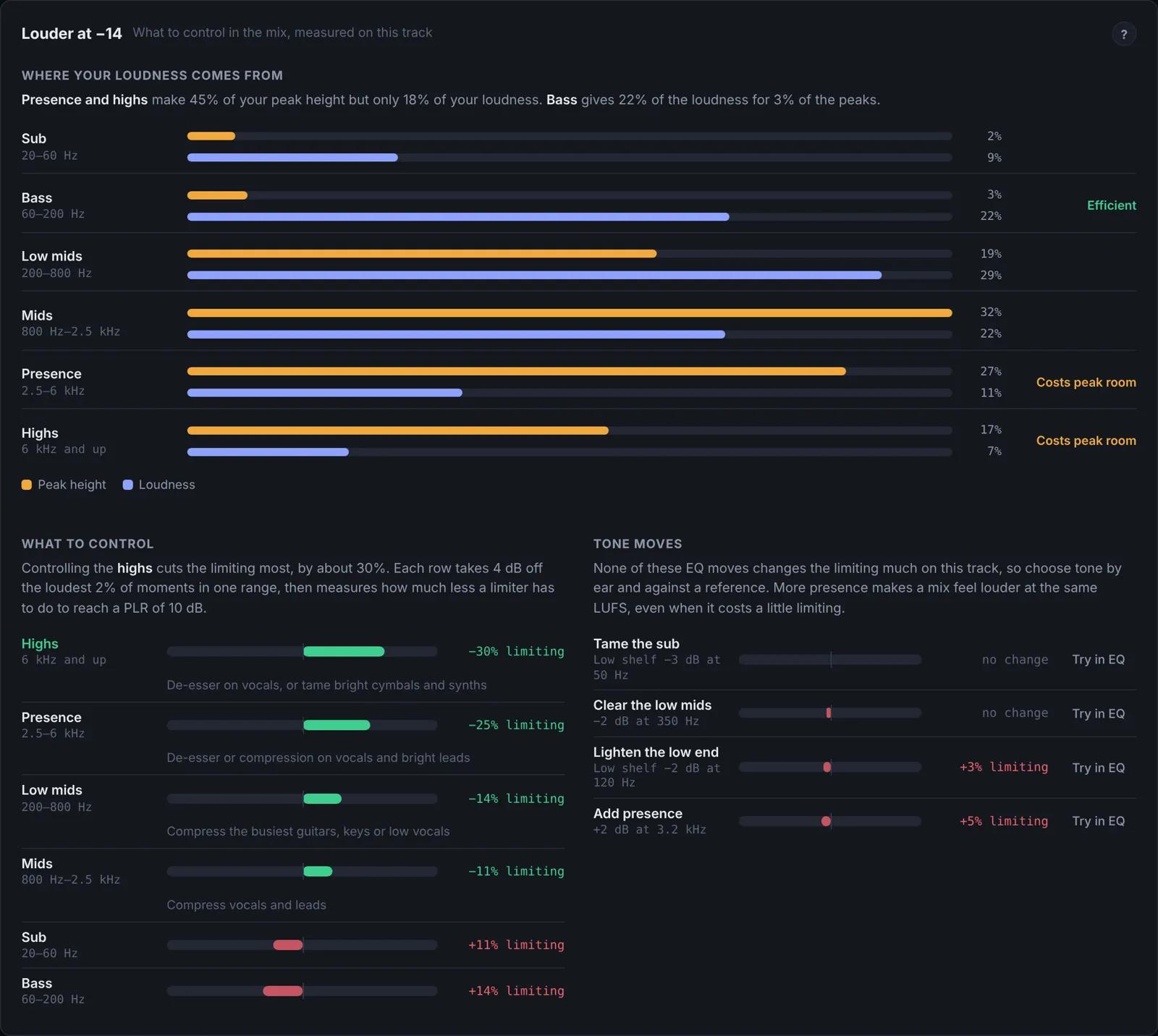
It also tells you whether those peaks are drum hits or sustained parts, and suggests the matching tool: a drum-bus clipper for hits, a de-esser or compression for a bright vocal or synth. For the clearest answer, analyse your mix with the master limiter switched off.