05
Measuring loudness: LUFS
LUFS (loudness units relative to full scale) measures loudness the way we hear it, following the ITU-R BS.1770 standard. Before measuring, the signal is filtered to match the ear: very low bass counts for less, and the upper mids and highs count for a little more. That is why a mix heavy in sub bass can read surprisingly quiet, and why a little more presence reads louder.
- Integrated loudness
- The loudness of the whole track: the number streaming services normalise to. Silence and very quiet passages are left out (anything below −70 LUFS, then anything more than 10 LU below the average), so adding silence or a quiet intro doesn't change it.
- Short-term loudness
- Loudness over a sliding 3-second window. It shows how loud each section is. The loudest short-term reading is how hard your chorus or drop hits.
- Momentary loudness
- The same over 0.4 seconds. It moves with individual hits and words.
- Loudness range (LRA)
- How much the short-term loudness varies across the song, in LU, ignoring the quietest 10% and loudest 5%. Roughly, under 5 LU is very consistent and 6 to 10 is typical of songs with breakdowns.
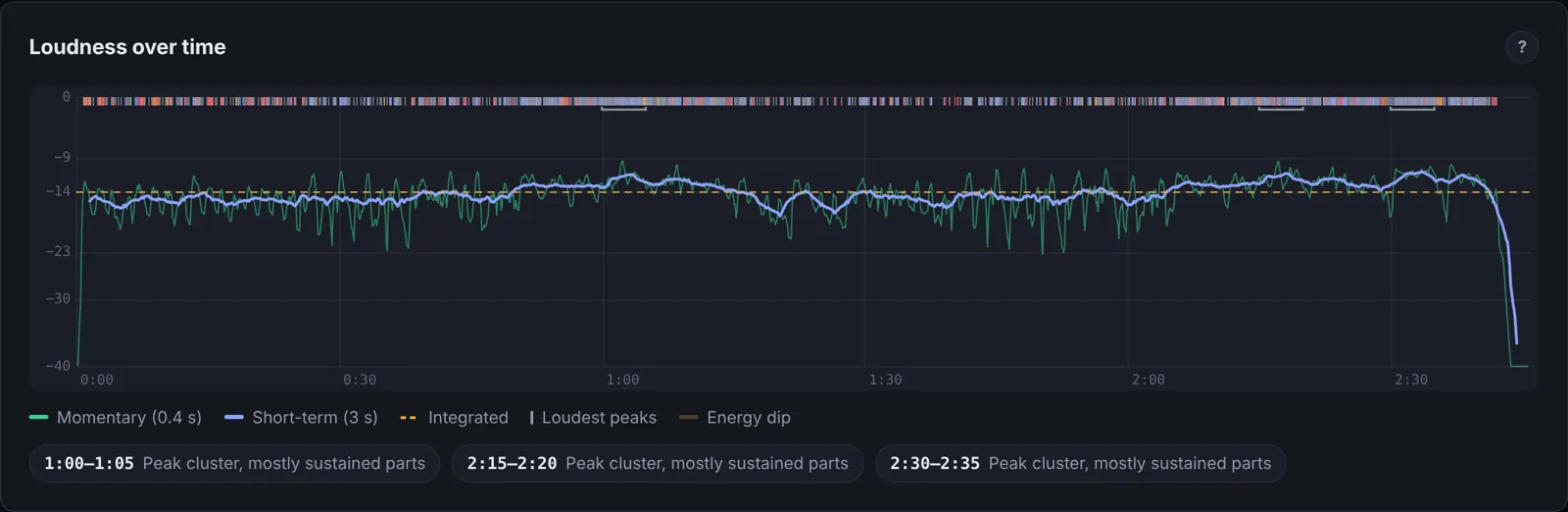
Energy dips are worth a look. A breakdown is meant to drop; a verse that sags 5 LU below the rest will feel small next to other releases at −14. More energy in the arrangement or a little level automation fixes it.
Put it into practiceOpen a mix in MasterScope, or get Liminal for your DAW.