Peaks: sample, true and codec
Loudness is about the body of the sound; peaks are its highest points. Three readings matter, each stricter than the last.
- Sample peak (dBFS)
- The highest sample value in the file. 0 dBFS is the top of the scale.
- True peak (dBTP)
- The highest point of the reconstructed waveform, including peaks that fall between samples. These "inter-sample peaks" can be well over the sample peak on dense, bright masters. Measured by oversampling.
- Codec peak
- The true peak after lossy encoding (Opus on YouTube, Ogg Vorbis on Spotify, AAC on Apple Music, MP3 on SoundCloud and downloads). Encoders remove the very top of the spectrum and add their own noise, and that reshapes the waveform so its peaks rise, often by 1 to 2 dB on loud, bright or clipped masters. MasterScope estimates it by filtering at 16 kHz and measuring the true peak; Liminal goes further and runs your song through the real Opus and Vorbis encoders.
The usual ceiling is −1 dBTP. Spotify recommends keeping true peak below −2 dBTP when your master is louder than −14 LUFS, because louder masters overshoot more when encoded. The codec estimate tells you directly: if it reads above −1 dBTP, the encoded version may distort wherever it plays at full level.
Liminal's ceiling modes
Under its Ceiling fader Liminal has three ceiling modes. True peak is the classic ceiling. Streaming also keeps the peaks a listener gets after Opus and Vorbis encoding under the ceiling: when you press Learn, Liminal encodes and decodes your song with the real encoders, measures how far its peaks rise, and calibrates its limiter to that song. All codecs adds a 1 dB margin for MP3 and AAC, which overshoot a little more (across 26 test masters, 128 kbps MP3 peaked at most 1.5 dB above Opus and Vorbis, and under 1 dB nine times out of ten).
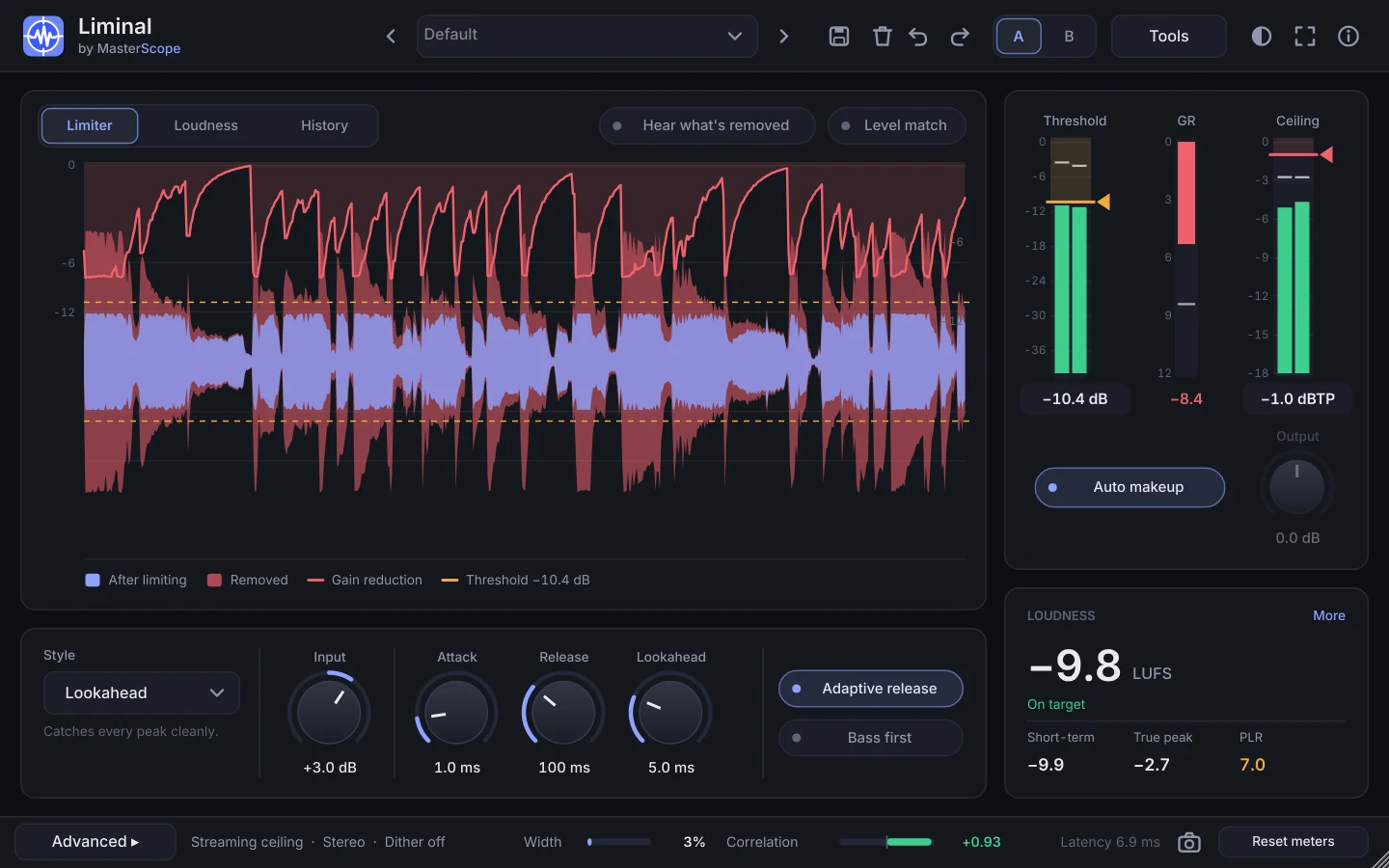
To hear it, open Tools in Liminal and press Codec check: the output plays through a real Opus encoder at 128 kbps, and the codec peak readout shows the decoded peak.